
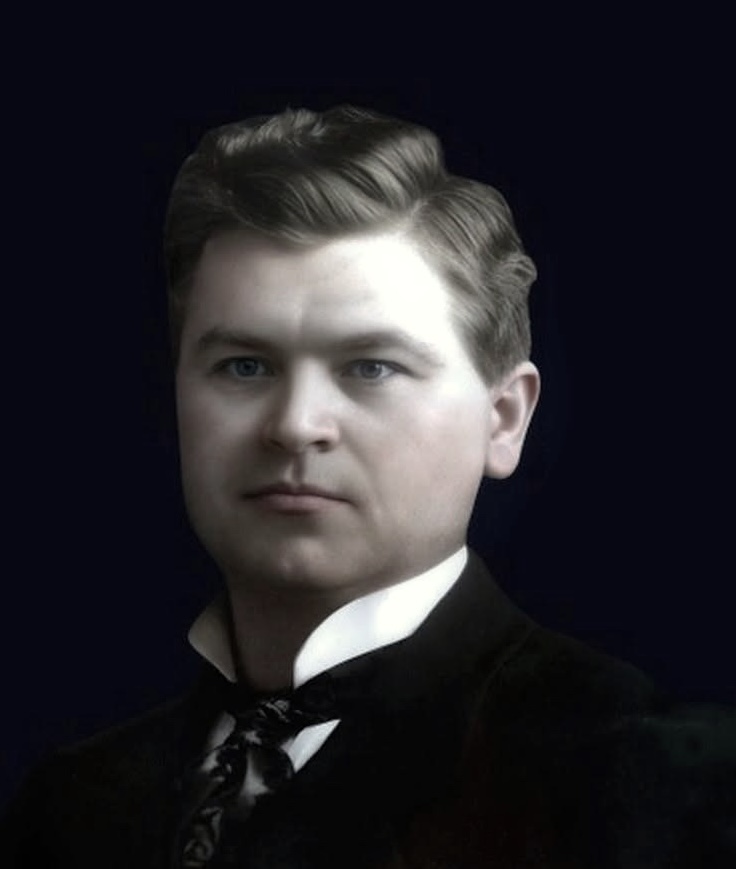
Viačasłaŭ Sieliach-Kačanski
Viačasłaŭ Antonavič Sieliach (Sieliach-Kačanski)
25 December 1885, Łahojsk, Minsk Governorate — 8 August 1976, South River, New Jersey
Belarusian opera singer (dramatic bass-baritone) and a prominent figure in musical theatre and the performing arts.
He graduated from the Maładziečna Teachers’ Seminary in 1905 and the St Petersburg Conservatory in 1915. From 1913 he performed at the Theatre of Musical Drama. In 1915 he became a soloist at the Mariinsky Theatre, where his roles included the Messenger in The Tale of Tsar Saltan, Boris Godunov in Boris Godunov, Shaklovity in Mussorgsky’s Khovanshchina, Igor in Prince Igor, and Grigory Gryaznoy in The Tsar’s Bride. In 1916 he also worked at the Alexandrinsky Theatre. He sang alongside Fyodor Chaliapin.
The presidium of the Arts Section of Inbelkult, 1926. From left to right, seated: K. S. Sierada, Julian Drejzin, Jazep Dyła, Anton Hrynievič, Mikałaj Ščakacichin; standing: Mikałaj Krasinski, Paŭlina Miadziołka, Viačasłaŭ Sieliach, Flaryjan Ždanovič. From 1924 he headed the music subsection of Inbelkult and taught opera and choral classes at the Belarusian Music College. His pupils included Pihuleŭski, Niaborskaja, Aškinazi, T. Banačyč, and Archipaŭ; L. Aleksandroŭskaja also studied singing with him for a time. In 1926 he founded the Belarusian Studio Choir, which was reorganised in 1928 as the Belarusian State Capella (now the State Academic Choral Capella of Belarus). He was the chief director and sang the role of the Miller in the first Belarusian-language production of Alexander Dargomyzhsky’s opera Rusalka, staged at the First Belarusian State Theatre (BDT-1) on 14–15 May 1927. He became director of BDT-1 in 1927 but was dismissed on charges of “national democratism”. From 1930 he was director of the Belarusian Theatre College and head of the Belarusian Drama Courses.
From 1933 he lived in Leningrad, serving as deputy director of the Rimsky-Korsakov Opera Studio and as a director of the Touring Opera of the All-Russian Theatre Society. From 1937 he worked in Ukraine.
In June 1943 he returned to his homeland, heading the arts department of the Belarusian Central Council (BCR) and the culture and arts department of Belarusian People’s Self-Help. At the same time, he was the head and chief director of the Minsk City Theatre. Together with Todar Lebiada, he staged Lebiada’s play A Wasted Life. From 1944 he lived in Berlin. Published accounts state that during this period Sieliach and M. Ravienski formed a concert and variety troupe attached to the Vineta propaganda organisation.
From 1950 he lived in the United States, organising choirs and theatre groups and arranging concerts and performances.
He composed church music, choral works, and songs setting verses by Belarusian poets.
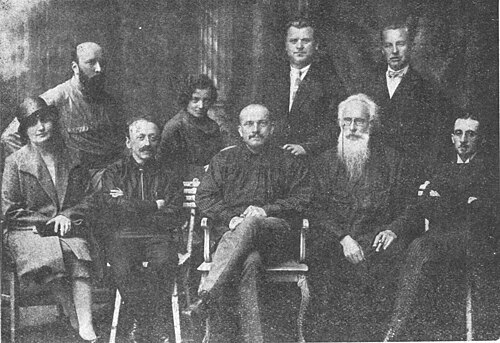
The presidium of the Arts Section of Inbelkult, 1926. From left to right, seated: K. S. Sierada, Julian Drejzin, Jazep Dyła, Anton Hrynievič, Mikałaj Ščakacichin; standing: Mikałaj Krasinski, Paŭlina Miadziołka, Viačasłaŭ Sieliach, Flaryjan Ždanovič.